 360ToolHub
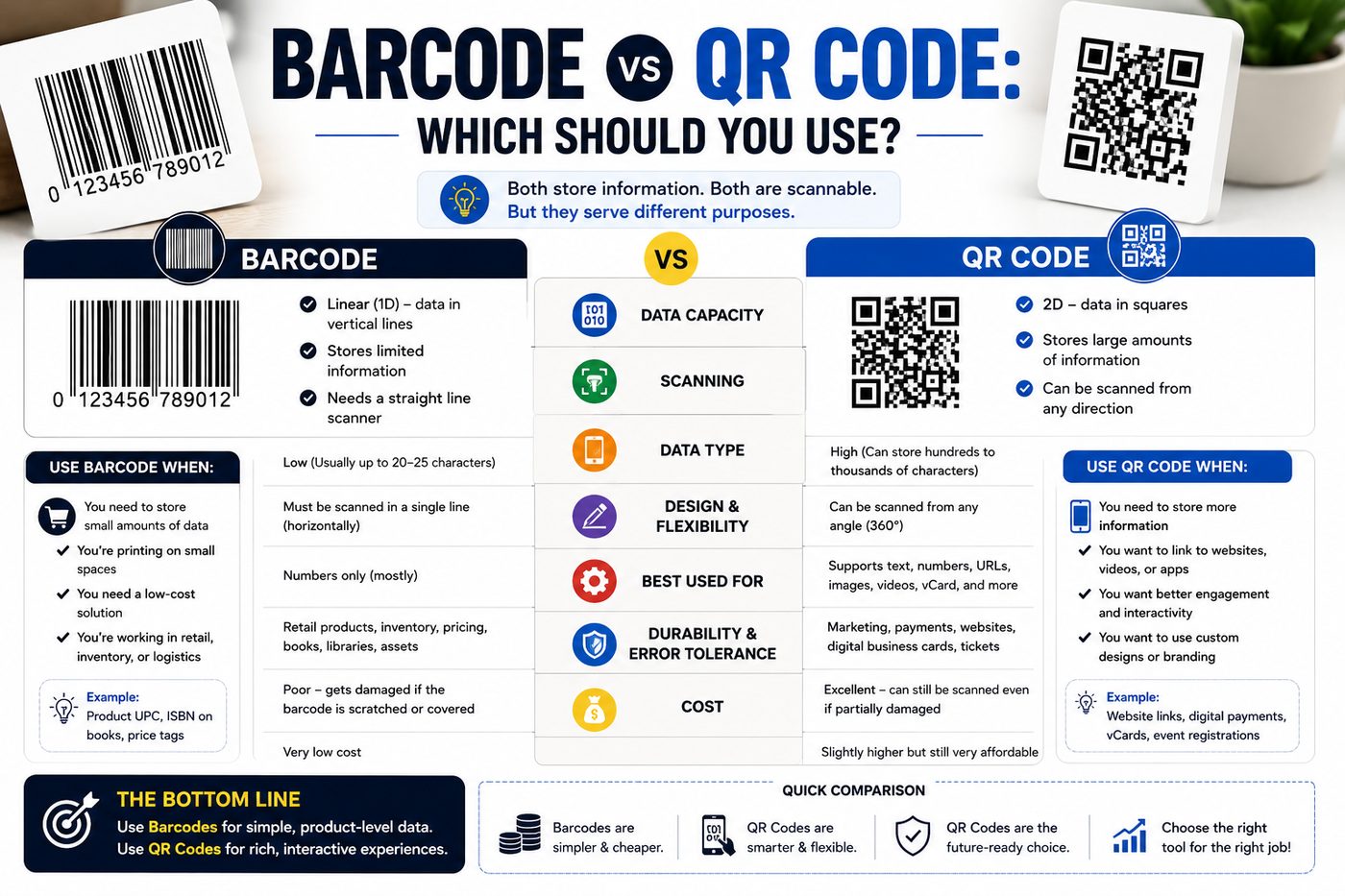
Both look like black-and-white squares or lines that a scanner reads, so it's easy to assume they're interchangeable. They're not — each was built for a different job.
The core difference
A traditional barcode (like UPC or EAN) is a 1D pattern that typically stores a short number — usually a product ID that a store's system looks up in a database. A QR code is a 2D pattern that can store far more data directly, like a full web address, WiFi credentials, or contact details, without needing a database lookup at all.
When a barcode is the right choice
- Retail products — UPC/EAN barcodes are the standard that point-of-sale systems and retailers expect.
- Inventory management — Code128 barcodes are common for internal stock tracking and shipping labels.
- Existing scanner infrastructure — if a business already has barcode scanners at checkout, sticking with barcodes avoids a hardware or workflow change.
Need a product or inventory barcode?
UPC, EAN-13, Code128, and Code39 — free, instant download.
When a QR code is the right choice
- Sending people somewhere digital — a menu, a website, a contact card, or WiFi access.
- Marketing materials — posters, flyers, and packaging where a phone camera (not a dedicated scanner) will be doing the scanning.
- No existing database needed — since the data is encoded directly in the pattern, there's nothing to look up.
Need to link somewhere digital?
Generate a QR code with optional logo and frame styles.
A simple way to decide
If a checkout system or retailer needs to look up a product in a database, use a barcode. If you want a phone camera to take someone straight to information — a link, a file, a contact — use a QR code. The two solve genuinely different problems, even though they look superficially similar.
The bottom line
Neither format is "better" — they're built for different jobs. Retail and inventory lean barcode; digital destinations and marketing lean QR.